Financial guidance or advice? How they differ and how to check a firm
Figures correct for the 2026/27 tax year. Last checked against GOV.UK, HMRC, MoneyHelper, the FCA and the Financial Ombudsman Service on .
Information, not financial advice. Life Cashflow is not authorised by the FCA.
Short answer
What is the difference between financial guidance and financial advice in the UK?
In the UK, guidance explains how things work and what the options are, in general terms. Free, impartial services such as MoneyHelper and Pension Wise provide it. Advice comes from a firm authorised by the Financial Conduct Authority, looks at your whole situation, is accountable under FCA rules and is usually paid for. Life Cashflow is neither.
 Open this example in the planner.
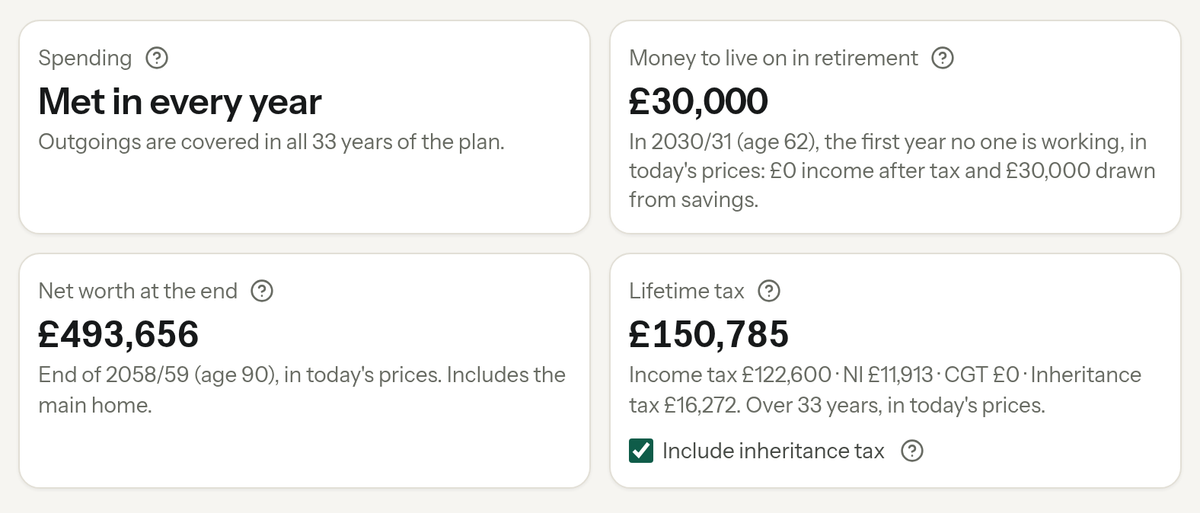
In this example, the planner's overview for Sam shows spending met in every year, £30,000 to live on in 2030/31, the first year without work, net worth of £493,656 at the end of 2058/59 including the home, and lifetime tax of £150,785 including an inheritance tax estimate of £16,272, in today's prices. It shows what the figures entered lead to, not what anyone ought to do. Sam is an invented example, and the overview is an illustration of the planner's arithmetic, not a forecast.
Assumes 2.5% inflation a year and steady growth of 5% a year on pensions and ISAs, and 3% on cash and the home, before charges. Tax rules are those for 2026/27 and later years as now legislated, and can change. Real returns vary, and the value of investments can go down as well as up.
Open this example in the plannerDownload Sam's example plan (a JSON file: in the planner, choose File, then Open a saved file)
Key facts
- Guidance is general and free when it comes from services such as MoneyHelper and Pension Wise. Advice is personal, regulated by the Financial Conduct Authority and usually paid for.
- Pension Wise offers free guidance appointments about defined contribution pension options to people aged 50 or over, and to some younger people, such as those retiring early because of ill health.
- Regulated advice is accountable under FCA rules, and you can complain to the firm and, if needed, the Financial Ombudsman Service.
- Firms must say whether they are independent or restricted before they advise you. Neither label says anything about the quality of the advice.
- In most cases the law requires advice first before giving up defined benefit (final salary) pension benefits worth more than £30,000.
- Life Cashflow does not endorse, rank or refer people to any adviser or firm, and the business behind it is not authorised by the FCA.
Financial guidance explains how things work and what the options are, in general terms, and is free and impartial from services such as MoneyHelper and Pension Wise. Financial advice is personal: a firm authorised by the Financial Conduct Authority looks at your whole situation, gives you a personal view on what to do, is accountable under FCA rules, and is usually paid for. Life Cashflow is neither. It shows what a set of assumptions leads to.
What is the difference between guidance and advice?
The words are often used loosely, but in the UK they describe different services with different protections.
| Aspect | Guidance | Advice |
|---|---|---|
| What it is | Free and general | Personal and regulated |
| What it does | Explains how things work and what the options are. | Looks at your whole situation and gives you a personal view on what to do. |
| How it is limited | Is general. It does not look at your whole situation or tell you what to do. | Comes from a firm authorised by the Financial Conduct Authority. |
| Protection | Is free and impartial when it comes from services such as MoneyHelper and Pension Wise. | Is accountable under FCA rules. You can complain to the firm and, if needed, the Financial Ombudsman Service. |
| Cost | Free | Usually paid for, by a fee. |
Where does Life Cashflow sit?
Neither of these. It is a modelling tool: you set the assumptions, it shows the arithmetic. It does not look at your wider circumstances, does not tell you what to do, and is not a regulated service. Treat its output as information.
Can you get financial advice for free?
Guidance is free; regulated advice is usually paid for. GOV.UK says of advice on workplace pensions that you will usually have to pay for it.
- MoneyHelper is the government-backed service for free, impartial money and pensions guidance, by phone, web chat and online.
- Pension Wise, part of MoneyHelper, gives free guidance appointments about the options for taking money from a defined contribution pension. They are for people aged 50 or over, and for some younger people, such as those retiring early because of ill health or with an inherited pension.
- Advice paid for in other ways. Some employers offer access to advice as part of their benefits. The pensions advice allowance lets members of defined contribution schemes take up to £500 tax-free from their pension towards retirement advice, once a tax year and up to three times, where the scheme allows it.
The planner itself points to Pension Wise. When someone in a plan is 50 or over and has a pension pot, the overview ends with this note.
 Open this example in the planner.
In this example, Sam is 58 and has a workplace pension, so the planner's overview ends with a note about Pension Wise, the government-backed service that gives free, impartial guidance to people aged 50 or over with a defined contribution pension. The note shows for anyone in a plan who is 50 or over and has a pension pot. Sam is an invented example, and the overview is an illustration of the planner's arithmetic, not a forecast.
Assumes 2.5% inflation a year and steady growth of 5% a year on pensions and ISAs, and 3% on cash and the home, before charges. Tax rules are those for 2026/27 and later years as now legislated, and can change. Real returns vary, and the value of investments can go down as well as up.
Open this example in the plannerDownload Sam's example plan (a JSON file: in the planner, choose File, then Open a saved file)
When do people look for regulated advice?
People often look for regulated advice when a decision is large, hard to reverse, or complicated. Common examples are:
- Thinking about giving up a defined benefit (final salary) pension. In most cases the law requires advice first when the benefits are worth more than £30,000.
- Choosing how to draw an income from a defined contribution pension, where the choices can have lasting effects.
- Complicated tax positions, such as several rental properties, business income or income from abroad.
- Inheritance tax, gifts, trusts and passing on wealth.
- Paying for long-term care.
- Big life events, such as divorce, bereavement or receiving an inheritance.
Some people also simply prefer to talk their situation through with a professional. None of this means anyone needs advice. That depends on the person, and Life Cashflow cannot tell you.
What is the difference between independent and restricted advisers?
Advice firms describe themselves in one of two ways, and FCA rules require them to tell you which applies before they advise you.
- Independent. The firm considers a broad range of products from across the market and gives advice that is not limited or influenced by a provider.
- Restricted. The firm limits its advice in some way, for example to the products of one provider, a short list of providers, or certain types of product. It must say so.
Neither label says anything about the quality of the advice. Asking a firm to explain which applies to it, and what that means in practice, is a normal part of a first conversation.
What do people ask an adviser or firm?
- Are you independent or restricted, and what does that mean for the advice I would get?
- What will I pay, in pounds, for the first meeting, the advice itself, and any ongoing service? What does an ongoing fee cover?
- Do you receive payments from any provider or product, and how do you handle conflicts of interest?
- Which qualifications do the people I would deal with hold, and which FCA permissions does the firm have?
- What happens if I am unhappy? Who can I complain to?
- What will you need from me, and how often will we review things?
Which public resources help people check a firm or find free guidance?
These are public bodies and services, listed for convenience and in no order of preference. Life Cashflow is not connected with them, and listing them is not an endorsement of any firm they mention.
- MoneyHelper (opens in a new tab). The government-backed service for free, impartial money and pensions guidance, by phone, web chat and online.
- FCA Register (opens in a new tab). The official record of firms and individuals authorised by the Financial Conduct Authority, and what each is permitted to do.
- MoneyHelper: find a retirement adviser (opens in a new tab). A public directory of firms that give regulated retirement advice, run by the government-backed MoneyHelper service.
- MoneyHelper: choosing a financial adviser (opens in a new tab). A guide to the types of adviser, how they are paid, and what to ask before you start.
- Pension Wise (opens in a new tab). Free, impartial guidance appointments about the options for a defined contribution pension, for people aged 50 or over.
- FCA ScamSmart (opens in a new tab). The regulator's guide to spotting investment and pension scams, and its list of warnings about unauthorised firms.
The four steps further down this page show how people check a firm on the FCA Register.
What this looks like in the planner
The picture at the top of this page is the planner's overview for Sam, an invented example: whether spending is met, money to live on in the first year without work, net worth at the end of the plan and tax over the whole plan. Open Sam's example in the planner to see it, and change any figure to see the results move.
That is the arithmetic of the figures entered. It is not what an adviser would give. Regulated advice looks at a person's whole situation, such as their objectives, their attitude to risk, their health and their family, and the products and providers open to them, and gives a personal view on what to do, for which the firm is accountable. The planner does none of that. What the planner simplifies or leaves out lists the rest of what it does not know.
Can a Life Cashflow plan be used in a conversation with an adviser?
You can show your plan on screen, or share a saved plan file, with anyone you choose. We do not send plans to advisers and have no network of them. Whether a projection is useful to a particular adviser is for them to say. A projection built on your own assumptions is a set of questions to ask, not a conclusion.
Step by step
- Search the FCA Register. Search the FCA Register (opens in a new tab) for the firm by name or by its reference number.
- Check its status and permissions. Check that its status is "Authorised" and that its permissions cover the kind of advice you are looking for, such as advising on pensions or investments.
- Check the contact details. Check that the phone number, address and website match what you were given. Use the details on the Register, not those in a message or advert, and call back on the Register number.
- Read the scam warnings. Read the regulator's ScamSmart guidance (opens in a new tab) and check the FCA warning list. Unsolicited calls about pensions are banned in the UK, and pressure to decide quickly is a warning sign.
Frequently asked questions
Is Life Cashflow financial advice?
No. It is a modelling tool. You set the assumptions and it shows the arithmetic. It does not look at your wider circumstances, does not tell you what to do, and is not a regulated service. Treat its output as information.
Can I speak to a financial adviser for free?
Free, impartial guidance is available from MoneyHelper, and Pension Wise gives free guidance appointments about defined contribution pension options to people aged 50 or over. Regulated advice is usually paid for. Some employers offer access to advice as a benefit, and some pension schemes let members take up to £500 tax-free from a defined contribution pension towards retirement advice, up to three times.
What is the difference between an independent and a restricted adviser?
An independent firm considers a broad range of products from across the market and gives advice that is not limited or influenced by a provider. A restricted firm limits its advice in some way, for example to one provider, a short list of providers or certain types of product, and must say so.
When do people look for regulated advice?
Often when a decision is large, hard to reverse or complicated - for example giving up a final salary pension, choosing how to draw an income from a defined contribution pension, complicated tax positions, inheritance tax, paying for long-term care, or big life events. None of this means anyone needs advice. That depends on the person.
Where can I get free guidance about pensions?
MoneyHelper is the government-backed service for free, impartial money and pensions guidance, and Pension Wise offers free guidance appointments about the options for a defined contribution pension for people aged 50 or over.
Can a Life Cashflow plan be shown to an adviser?
Yes, if you choose to. You can show a plan on screen, or share a saved plan file, with anyone. Life Cashflow does not send plans to advisers and has no network of them, and whether a projection is useful to a particular adviser is for them to say.
Try this example in the planner
Sam's example opens on the Overview, which shows what the figures entered lead to. The planner is free and works in your browser; you can show a plan, or share a saved plan file, with anyone you choose.
The example is invented. It opens as a scenario of its own that you can change, and anything of yours that is open stays as it is.
Download Sam's example plan as a JSON file, and open it in the planner with File, then Open a saved file.
Sources
Checked against these sources on , for the 2026/27 tax year.
- MoneyHelper (opens in a new tab) (moneyhelper.org.uk)
- Pension Wise (MoneyHelper) (opens in a new tab) (moneyhelper.org.uk)
- MoneyHelper - find a retirement adviser (opens in a new tab) (moneyhelper.org.uk)
- MoneyHelper - choosing a financial adviser (opens in a new tab) (moneyhelper.org.uk)
- Transferring your pension (GOV.UK) (opens in a new tab) (gov.uk)
- Pensions Tax: Pensions Advice Allowance (HMRC, GOV.UK) (opens in a new tab) (gov.uk)
- Pension transfer advice: what to expect (FCA) (opens in a new tab) (fca.org.uk)
- Financial Conduct Authority Register (opens in a new tab) (register.fca.org.uk)
- FCA ScamSmart - protect yourself from scams (opens in a new tab) (fca.org.uk)
- Financial Ombudsman Service (opens in a new tab) (financial-ombudsman.org.uk)