How pension and investment fees add up over time
Figures correct for the 2026/27 tax year. Last checked against GOV.UK, The Pensions Regulator and MoneyHelper on .
Information, not financial advice. Life Cashflow is not authorised by the FCA.
Short answer
How do percentage charges on pensions and investments add up over time?
Most pensions and investment accounts charge a percentage of the money held each year. Because the money taken stops growing, a charge removes both the amount itself and the growth it would have earned. Over several decades the gap between two charge levels grows faster than the gap between the percentages suggests.
 Open this example in the planner.
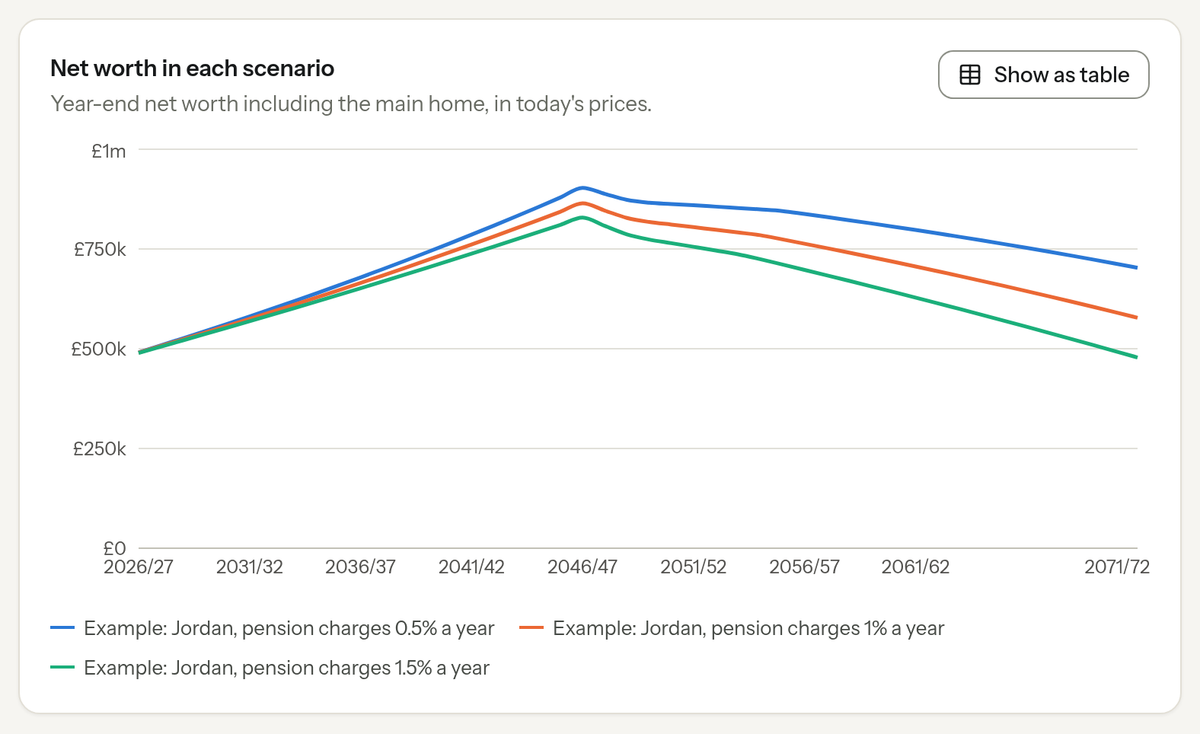
In this example, the same person has pension charges of 0.5%, 1% and 1.5% a year, with everything else the same. When Jordan stops work at 66 the pension is worth £549,111, £510,398 and £474,750, and the charges taken over the whole plan come to £88,313, £154,108 and £201,864, in today's prices. Jordan is an invented example, and the chart is an illustration of the planner's arithmetic, not a forecast.
Assumes 2.5% inflation a year and steady growth of 5% a year on pensions, and 3% on cash and the home, before charges. Tax rules are those for 2026/27 and later years as now legislated, and can change. Real returns vary, and the value of investments can go down as well as up.
Open this example in the plannerDownload Jordan's example plan (a JSON file: in the planner, choose File, then Open a saved file)
Key facts
- Charges are usually a percentage of the pot each year - platform, fund, advice and transaction costs can all apply to one product.
- A charge is taken from a pot that is itself growing, so over decades it costs more than the percentage alone suggests.
- Example - £100,000 growing at 5% a year for 25 years ends at about £298,751 with a 0.5% yearly charge and about £263,398 with a 1% charge, a gap of about £35,353.
- Charges on the default fund of a workplace pension used for automatic enrolment are capped at 0.75% a year of the money in it, not counting transaction costs.
- In the planner each pension pot has a yearly charge as a percentage of the pot, and the results show the total taken in pension charges.
Most pensions and investment accounts charge a percentage of the money held each year. Because the money taken stops growing, a charge costs the amount itself plus the growth it would have earned, so a small-looking percentage adds up over decades. This guide shows the arithmetic with a worked example, an illustration you can change, and an invented example in the planner.
What kinds of charges do pensions and investments have?
Most pensions and investment accounts charge a percentage of the money held, taken out gradually over the year. The label differs between products, and a single product can have more than one:
- Platform or administration charge. For holding the account.
- Fund or ongoing charge. For running the funds held in the account.
- Advice charge. If a regulated adviser is paid from the pot. It may be a percentage, a fixed sum or both.
- Transaction costs and other charges. For buying and selling investments, or for leaving a product. Not every product has them.
What is charged, and what the charge pays for, is set out in each product's own documents. This guide does not compare products and names none.
Is there a cap on workplace pension charges?
There is a cap on the default fund of a workplace pension scheme used for automatic enrolment. Government guidance sets it at 0.75% a year of the money in the default arrangement, or an equivalent combination charge. The cap covers the scheme and investment administration charges that members pay, and leaves out transaction costs and a few other costs, such as some costs of winding up a scheme.
The cap applies to the default arrangement only, so funds a member chooses instead are outside it, and so are pensions not used for automatic enrolment. The Pensions Regulator describes it from an employer's side: charges paid out of member savings in default arrangements must be no higher than 0.75% a year of the member's fund.
Why does the effect of a charge grow over time?
A charge is taken from a pot that is itself growing. The money taken stops growing, so a charge removes the amount itself plus all the growth that amount would have had in later years. Over short periods that is small. Over several decades the gap between two charge levels grows faster than the gap between the percentages suggests.
What does a worked example look like?
This example uses a starting pot of £100,000 growing at 5% a year before charges, with the charge taken each year from the grown pot, for 25 years. The amounts are in future pounds.
| Yearly charge | Pot after 25 years | Total charges taken |
|---|---|---|
| 0.5% | £298,751 | £23,317 |
| 1% | £263,398 | £43,435 |
The pot with the lower charge is about £35,353 larger after 25 years. The illustration below shows the same arithmetic, and you can change every number in it. It is not a view on what is reasonable to pay, and it does not apply to any particular product.
Charges over time: an illustration
Illustration onlyChange the numbers to see the arithmetic. Each year the pot grows by the growth rate, then the charge is taken as a percentage of the pot. There are no contributions, withdrawals, tax or inflation, and the amounts are in future pounds.
- Pot with charge A (0.5%)
- £298,751
- Charges taken: £23,317
- Pot with charge B (1%)
- £263,398
- Charges taken: £43,435
- Difference
- £35,353
- After 25 years
The pot with the lower charge is £35,353 larger after 25 years.
What this does and does not show
What this looks like in the planner
The planner works charges out inside a whole plan, with contributions, withdrawals, tax and inflation, rather than on one pot on its own. Jordan's invented example has the same plan three times, with pension charges of 0.5%, 1% and 1.5% a year and everything else the same.
- Net worth in each scenario. The picture at the top shows the three lines starting together and moving apart: the higher the charge, the lower the line, in every year.
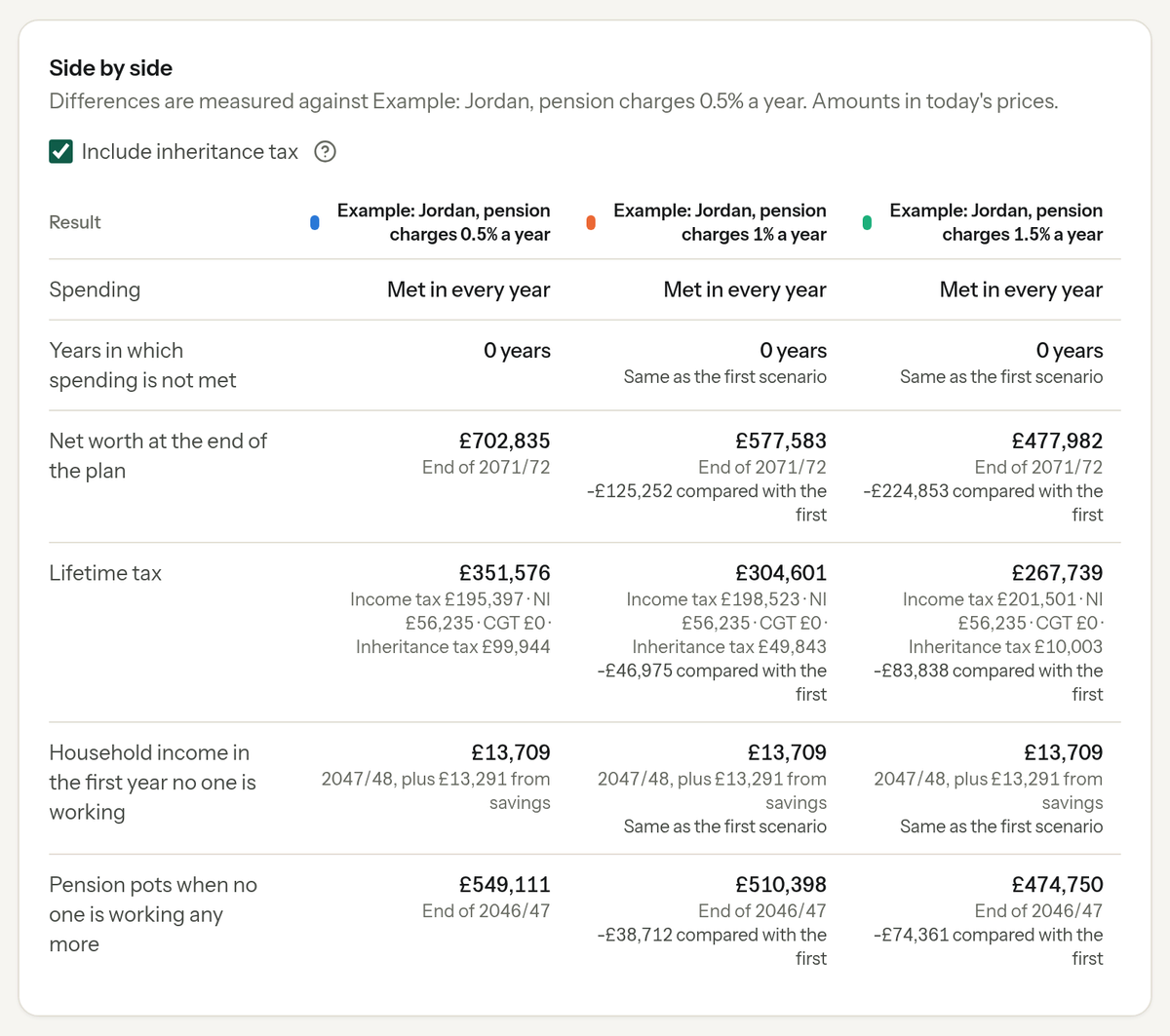
- Side by side. The Compare view's table puts the main results next to each other, with the difference from the first scenario under each figure.
 Open this example in the planner.
In this example, the planner's side-by-side table compares pension charges of 0.5%, 1% and 1.5% a year for the same person. The pension pots at the end of 2046/47, the last year of work, are £549,111, £510,398 and £474,750, and net worth at the end of the plan is £702,835, £577,583 and £477,982, in today's prices. Jordan is an invented example, and the table is an illustration of the planner's arithmetic, not a forecast.
Assumes 2.5% inflation a year and steady growth of 5% a year on pensions, and 3% on cash and the home, before charges. Tax rules are those for 2026/27 and later years as now legislated, and can change. Real returns vary, and the value of investments can go down as well as up.
Open this example in the plannerDownload Jordan's example plan (a JSON file: in the planner, choose File, then Open a saved file)
Open Jordan's example in the planner to see both. The Overview of each scenario also shows the total taken in pension charges over the plan. The example's growth rates are assumptions, and real returns go up and down; the charges are the only difference between the three scenarios.
What does the illustration leave out?
- Payments in and out of the pot. Real pots usually receive contributions or pay out an income.
- Tax. Pensions, ISAs and other accounts are taxed differently, and tax changes the amount you keep.
- Inflation. The amounts are in future pounds, not in today's money.
- Uneven returns. Real investments do not grow at one steady rate.
- Fixed-sum charges, which do not scale with the size of the pot.
- What you receive for a charge. Services, investment choice and support differ between products.
How are charges treated in your own plan?
Each pension pot in the planner has a yearly charge, entered as a percentage of the pot, and the results show the total taken in pension charges over the plan. Savings and investment accounts have a single growth rate, so any charge on them can be reflected by entering the growth rate after charges.
Where does tax fit in?
Tax affects what is left after charges. The planner works out income tax, National Insurance, tax on dividends, savings and property income, capital gains tax and student loan repayments year by year, using the rules for each tax year. UK tax rates and allowances 2026/27 lists the rules and the current tax figures.
For free, impartial explanations of pension and investment charges, see MoneyHelper (opens in a new tab).
See charges and tax together in a full plan of your own.
Start your planFrequently asked questions
What types of charge can a pension or investment account have?
A platform or administration charge for holding the account, a fund or ongoing charge for running the funds held, an advice charge if a regulated adviser is paid from the pot, and transaction costs or other charges for buying and selling investments or leaving a product. Not every product has all of them.
Is there a cap on pension charges?
For the default fund of a workplace pension scheme used for automatic enrolment, yes. The charge cap is 0.75% a year of the money in the default arrangement, or an equivalent combination charge. It covers scheme and investment administration charges paid by members, and leaves out transaction costs and a few other costs. Funds chosen instead of the default are outside it.
Why does a small percentage charge matter over a long time?
A charge is taken from a pot that is itself growing. The money taken stops growing, so a charge removes the amount itself plus all the growth that amount would have had in later years. Over short periods that is small. Over several decades the gap grows faster than the gap between the percentages.
Does a lower charge mean a better result?
Not by itself. What you receive for a charge differs from one product to another, including services, investment choice and support. The illustration shows arithmetic on the numbers typed in. It is not a view on what is reasonable to pay.
How does Life Cashflow treat charges in a plan?
Each pension pot has a yearly charge, entered as a percentage of the pot. Savings and investment accounts have a single growth rate, so any charge on them can be reflected by entering the growth rate after charges.
Try this example in the planner
Jordan's example opens on the Compare view, with the same plan at charges of 0.5%, 1% and 1.5% a year. Changing the charge, or any other figure, shows how the gap moves.
The example is invented. It opens as a scenario of its own that you can change, and anything of yours that is open stays as it is.
Download Jordan's example plan as a JSON file, and open it in the planner with File, then Open a saved file.
Sources
Checked against these sources on , for the 2026/27 tax year.
- The charge cap: guidance for trustees and managers of occupational schemes (DWP, GOV.UK) (opens in a new tab) (gov.uk)
- What to look for in a pension scheme (The Pensions Regulator) (opens in a new tab) (thepensionsregulator.gov.uk)
- MoneyHelper - free, impartial guidance on pensions and investments (opens in a new tab) (moneyhelper.org.uk)