Income tax and National Insurance
UK tax rates and allowances 2026/27 used by the planner
Figures correct for the 2026/27 tax year. Last checked against GOV.UK and HMRC on .
Information, not financial advice. Life Cashflow is not authorised by the FCA.
Short answer
Which UK tax rules and rates does the Life Cashflow planner use?
The planner uses the published UK rules for the current tax year plus changes already in legislation. That covers income tax in England, Wales, Northern Ireland and Scotland, National Insurance, savings interest, dividends, rental income and Section 24, capital gains tax and student loans. The figures come from the same tables the planner calculates with.
 Open this example in the planner.
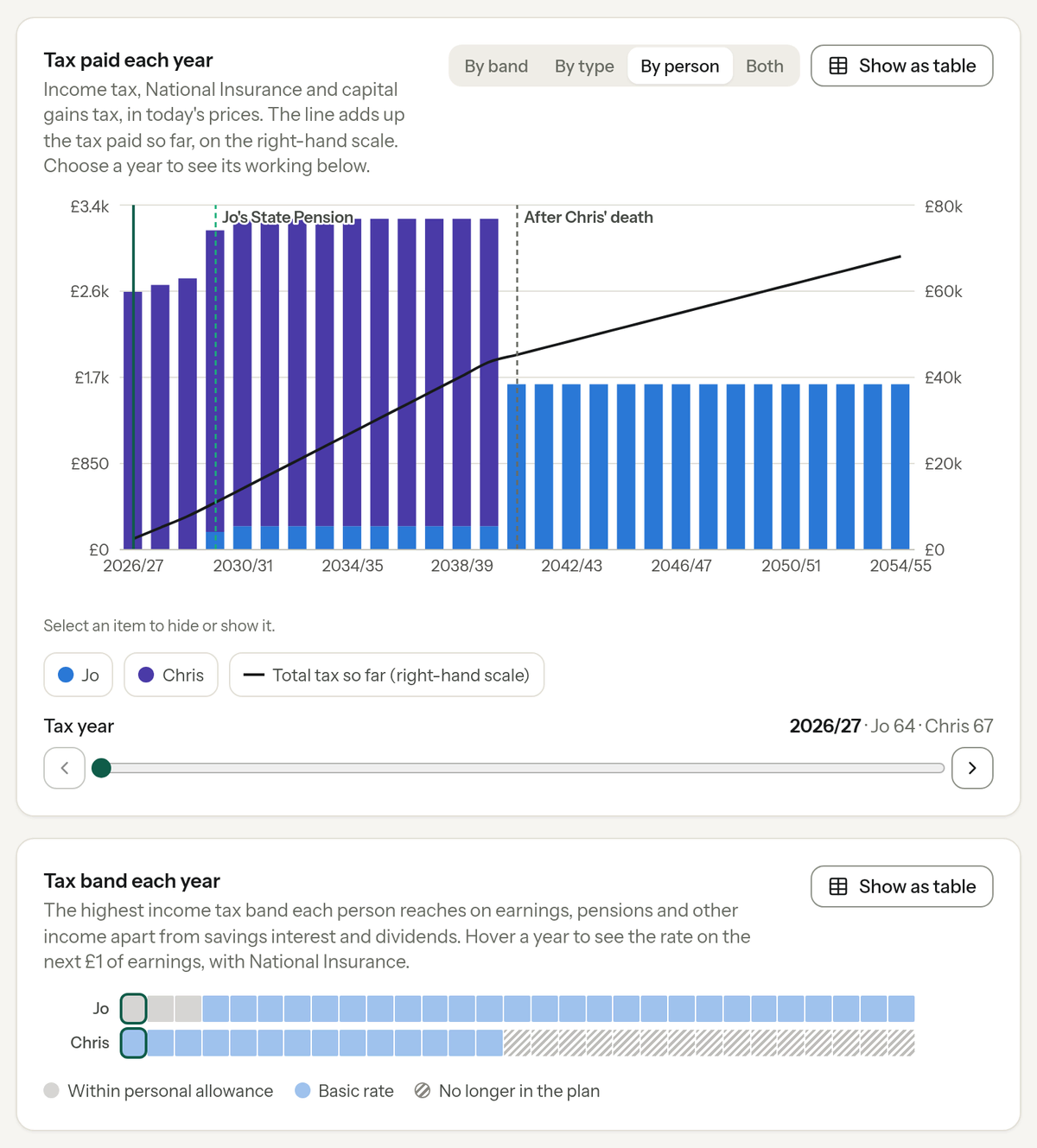
In this example, tax is worked out for each person separately, with their own allowances and bands. Over the plan Jo pays £26,974 and Chris pays £41,126 in income tax, National Insurance and capital gains tax, in today's prices. Jo and Chris are an invented example, and the chart is an illustration of the planner's arithmetic, not a forecast.
Assumes 2.5% inflation a year and steady growth of 5% a year on pensions and ISAs, and 3% on cash and the home, before charges. Tax rules are those for 2026/27 and later years as now legislated, and can change. Real returns vary, and the value of investments can go down as well as up.
Open this example in the plannerDownload Jo and Chris's example plan (a JSON file: in the planner, choose File, then Open a saved file)
Key facts
- The personal allowance is £12,570 for 2026/27, withdrawn at £1 for every £2 of adjusted net income above £100,000.
- Each person's income is stacked in a fixed order - ordinary income, property income, savings interest, then dividends - and the personal allowance is used against it in that order.
- Tax thresholds are fixed in law until 5 April 2031. After that the planner raises them with its inflation assumption, or keeps them frozen if you choose that setting.
- From April 2027 savings interest and property income have their own rates, two percentage points above the ordinary rates.
- The State Pension is taxable income but is paid without tax taken off.
- Employer National Insurance and voluntary Class 2 and Class 3 contributions are not modelled.
For 2026/27 the planner uses the published UK figures, including a personal allowance of £12,570 and income tax at 20%, 40% and 45% in England, Wales and Northern Ireland, with six rates in Scotland. It applies the changes already in legislation for later years: the freeze on thresholds to April 2031, new rates on savings and property income from April 2027, and pensions joining the inheritance tax estate from April 2027. Each group of figures below has its own table, built from the same tables the planner calculates with.
Tax rules can change. If a rule here looks out of date or wrong, please email support@lifecashflow.co.uk and we will look into it.
What are the income tax rates and bands for 2026/27?
In England, Wales and Northern Ireland the personal allowance is £12,570. With the full allowance, income from £12,571 to £50,270 is taxed at 20%, from £50,271 to £125,140 at 40%, and above £125,140 at 45%. The personal allowance is withdrawn at £1 for every £2 of adjusted net income above £100,000, which is the 60% tax trap.
| Personal allowance | £12,570 |
|---|---|
| Allowance reduced above income of | £100,000 |
| Marriage Allowance transfer | £1,260 |
| Basic rate | 20% on the first £37,700 |
| Higher rate | 40% from £37,700 to £125,140 |
| Additional rate | 45% above £125,140 |
Each person's income is sorted into four types and stacked in this order: ordinary income (earnings, pensions and other taxable income), property income, savings interest, then dividends. The personal allowance is used against them in that order, and what remains is taxed in bands.
- Personal allowance. Pension contributions paid by relief at source reduce adjusted net income, so they can restore some of the allowance.
- Wales. Welsh rates are currently the same as those in England and Northern Ireland, so Wales is not modelled separately.
- Tax reductions. Marriage Allowance and the Section 24 property reduction come off the final bill. They are described in couples and inheritance tax and in the property section below.
What are the Scottish income tax rates for 2026/27?
A person marked as a Scottish taxpayer has ordinary and property income taxed at the six Scottish rates in the table, from the 19% starter rate to the 48% top rate. Savings interest and dividends are taxed at the UK-wide rates, as the rules require. Scottish bands beyond the latest published year are projected the same way as UK thresholds. They are not a forecast of future Scottish Budgets.
| Starter rate | 19% on the first £3,967 |
|---|---|
| Basic rate | 20% from £3,967 to £16,956 |
| Intermediate rate | 21% from £16,956 to £31,092 |
| Higher rate | 42% from £31,092 to £62,430 |
| Advanced rate | 45% from £62,430 to £125,140 |
| Top rate | 48% above £125,140 |
What are the National Insurance rates for 2026/27?
Employees pay Class 1 National Insurance at 8% on earnings between the primary threshold and the upper earnings limit, and 2% above it. Self-employed profits pay Class 4 in the same way, with their own limits and rates. Neither is charged from the tax year after a person reaches State Pension age. Both are worked out on annual earnings rather than pay period by pay period, which can differ a little from a real payslip.
| Class 1 primary threshold | £12,570 |
|---|---|
| Class 1 upper earnings limit | £50,270 |
| Class 1 rates (main / above limit) | 8% / 2% |
| Class 4 profits limits (lower / upper) | £12,570 / £50,270 |
| Class 4 rates (main / above limit) | 6% / 2% |
Salary sacrifice contributions are free of National Insurance at present. From April 2029 the model applies the announced cap, so that sacrificed contributions above it count as pay for National Insurance. Employer National Insurance and voluntary Class 2 and Class 3 contributions are not modelled.
How is savings interest taxed in 2026/27?
Interest on cash is taxed as savings income. The first slice may be covered by the 0% starting rate for savings, which shrinks as other income rises, and then by the Personal Savings Allowance, which is lower for higher-rate taxpayers and nil for additional-rate taxpayers. The rest is taxed at the savings rates. Those rates rise by two percentage points from April 2027. Interest in cash ISAs and pensions is not taxed.
| Starting rate band | £5,000 at 0% |
|---|---|
| Personal Savings Allowance | £1,000 / £500 / £0 |
| Rates (basic / higher / additional) | 20% / 40% / 45% |
What are the dividend allowance and rates for 2026/27?
Dividends sit on top of other income. The first slice is covered by the dividend allowance and the rest is taxed at dividend rates, which depend on the band the income falls in. General investment accounts pay out part of their return as dividends each year, using the income yield you set. That part is taxed in the year it arises and then reinvested. Dividends inside ISAs and pensions are not taxed.
| Dividend allowance | £500 |
|---|---|
| Rates (basic / higher / additional) | 10.75% / 35.75% / 39.35% |
How is rental income taxed, including Section 24?
Rental profit is rent less running costs. Mortgage interest on a rental property is not deducted from that profit. Under the Section 24 rules for residential lettings it instead gives a tax reduction at the basic rate, applied to the lowest of the finance costs, the rental profit, and the person's other taxable income above the allowance.
Until April 2027 rental profit is taxed as ordinary income. From April 2027 it has its own rates in England, Wales and Northern Ireland, two percentage points above the ordinary rates, and the planner gives the Section 24 reduction at the new property basic rate. In Scotland, property income stays on the Scottish rates.
| Rates (basic / higher / additional) | Taxed as ordinary income |
|---|---|
| Section 24 finance cost reduction | 20% |
What are the capital gains tax rates and allowance for 2026/27?
Gains are charged when they are realised: when general investment accounts, crypto holdings or other investments are sold to fund spending, when a rental property is sold, or when you add a gain as a life event. The annual exempt amount comes off first. The rest is taxed at the lower rate up to whatever is left of the basic-rate band after income, and at the higher rate above that. ISAs and pensions do not produce gains. The main home is never sold in the model, so it never produces a gain.
| Annual exempt amount | £3,000 |
|---|---|
| Other assets (lower / higher rate) | 18% / 24% |
| Residential property (lower / higher rate) | 18% / 24% |
What are the pension allowances for 2026/27?
The annual allowance is £60,000 for 2026/27, tapered for people with high incomes, and the Money Purchase Annual Allowance is £10,000 for people who have taken taxable income flexibly from a pension. The Lump Sum Allowance caps tax-free cash at £268,275 for most people. Pension drawdown, tax-free cash and the State Pension explains how each limit works.
| Annual allowance | £60,000 |
|---|---|
| Taper: threshold income | £200,000 |
| Taper: adjusted income | £260,000 |
| Minimum tapered allowance | £10,000 |
| Money Purchase Annual Allowance | £10,000 |
| Lump Sum Allowance (tax-free cash) | £268,275 |
| Relief at source rate | 20% |
| Gross contribution allowed with no earnings | £3,600 |
How much is the State Pension in 2026/27?
The full new State Pension is £241.30 a week in 2026/27. It is taxable income, but it is paid without tax taken off; GOV.UK explains that tax on it is usually collected through the tax code on other income. In the planner it is added to each year's taxable income, so it uses up part of the personal allowance first. How much tax will I pay on my pension? works through an invented example with the State Pension and a pension withdrawal.
| Full new State Pension, a year | £12,547.60 |
|---|---|
| Qualifying years for the full amount | 35 |
| Minimum qualifying years | 10 |
What is the ISA allowance for 2026/27?
The table shows the annual ISA limit the planner applies when it saves spare income into ISAs. Interest, dividends and gains inside an ISA are not taxed.
| Annual ISA limit | £20,000 |
|---|
What are the student loan repayment thresholds for 2026/27?
Repayments are a percentage of employment and self-employment earnings above the threshold for each plan (Plans 1, 2, 4 and 5, and postgraduate loans). They stop when the balance you entered reaches zero. Thresholds are announced a year or two ahead. After the last announced figure the model raises them with the inflation assumption. Interest added to loans and write-off dates are not modelled.
| Plan 1 threshold | £26,900 at 9% |
|---|---|
| Plan 2 threshold | £29,385 at 9% |
| Plan 4 threshold | £33,795 at 9% |
| Plan 5 threshold | £25,000 at 9% |
| Postgraduate threshold | £21,000 at 6% |
What are the inheritance tax thresholds for 2026/27?
The planner's end-of-plan estimate uses the nil-rate band, the residence nil-rate band and its taper for larger estates, and the main rate. Couples and inheritance tax explains the estimate and what it leaves out, and inheritance tax on pensions from April 2027 explains the change for pensions.
| Nil-rate band | £325,000 |
|---|---|
| Residence nil-rate band | £175,000 |
| Residence band reduced above estate of | £2,000,000 |
| Rate | 40% |
| Unused pensions count in the estate | No |
How do the figures change in later years?
Thresholds are fixed in law until 5 April 2031. After that the planner raises them with its inflation assumption, 2.5% a year to begin with, or keeps them frozen if you choose that setting. Some limits are fixed amounts in law and stay the same in every year, such as the £100,000 point at which the personal allowance starts to be withdrawn.
How some of the figures change after 2026/27 under the planner's starting assumptions. Years marked Projected were not published by HMRC.
| Figure | 2026/27 | 2027/28Projected | 2031/32Projected |
|---|---|---|---|
| Personal allowance | £12,570 | £12,570 | £12,884 |
| Basic-rate band (taxable income up to) | £37,700 | £37,700 | £38,643 |
| Savings: basic rate | 20% | 22% | 22% |
| Dividends: basic rate | 10.75% | 10.75% | 10.75% |
| Property income: basic rate | As ordinary income | 22% | 22% |
| Salary sacrifice exempt from NI up to | No cap | No cap | £2,000 |
| Student loan Plan 2 threshold | £29,385 | £29,385 | £30,873 |
| Inheritance tax nil-rate band | £325,000 | £325,000 | £333,125 |
| Unused pensions in the estate | No | Yes | Yes |
What this looks like in the planner
The Tax view shows the tax paid each year and, for any year, its full working. The picture at the top of this page is Jo and Chris, an invented married couple, with tax split by person: each has their own allowances and bands, and the strip under the chart shows the highest band each of them reaches.
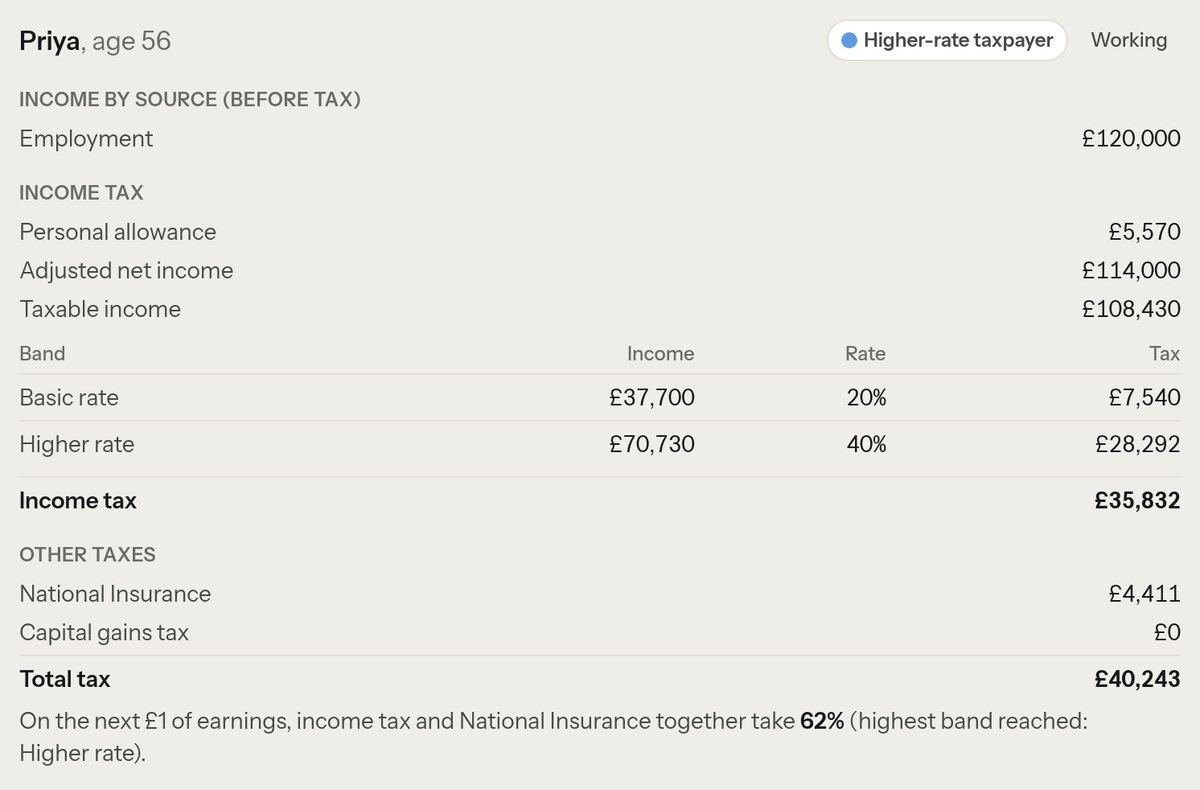
The year detail shows how one year's tax is worked out, from income by source to the rate on the next £1. In Priya's example the personal allowance is reduced because adjusted net income is over £100,000.
 Open this example in the planner.
In this example, Priya earns £120,000 in 2026/27 and pays into a workplace pension from pay before tax, so adjusted net income is £114,000. The personal allowance falls by £7,000, from £12,570 to £5,570, and the planner shows 62% taken from the next £1 of earnings: 60% income tax and 2% National Insurance. Priya is an invented example, and the year detail is an illustration of the planner's arithmetic, not a forecast.
Assumes 2.5% inflation a year and steady growth of 5% a year on pensions and ISAs, and 3% on the home, before charges. Tax rules are those for 2026/27 and later years as now legislated, and can change. Real returns vary, and the value of investments can go down as well as up.
Open this example in the plannerDownload Priya's example plan (a JSON file: in the planner, choose File, then Open a saved file)
Open Jo and Chris's example on the Tax view or Priya's example, and choose any year to see its working. The examples are invented and their figures are illustrations of the planner's arithmetic, not forecasts.
Frequently asked questions
What is the personal allowance for 2026/27?
£12,570. It is reduced by £1 for every £2 of adjusted net income above £100,000, so it is nil from £125,140. Married couples and civil partners can transfer part of it to the other partner through Marriage Allowance when the conditions are met.
Is the State Pension taxable?
Yes. GOV.UK says tax is usually paid on income from pensions, including the State Pension, but the State Pension is not taxed before it is received. Tax on it is usually collected through the tax code on other pension or work income. In the planner it is added to each year's taxable income.
Does the planner model Scottish income tax?
Yes. A person marked as a Scottish taxpayer has ordinary and property income taxed at the six Scottish rates. Savings interest and dividends are taxed at the UK-wide rates, as the rules require. Welsh rates are currently the same as those in England and Northern Ireland, so Wales is not modelled separately.
Which tax year do the figures on this page belong to?
2026/27, the tax year in the title. The tables are built from the same tables the planner uses, for that year, and the later years shown are marked as projected when HMRC has not published them. They are built from the latest published figures and the changes already in legislation.
How does the planner tax a pension withdrawal?
A withdrawal from a pension is taxed as income in the year it is taken, apart from any tax-free cash. Covering £1 of spending can need more than £1 withdrawn, so the planner works out the larger gross amount that leaves enough after tax.
Are interest and dividends inside an ISA or pension taxed?
No. Interest in cash ISAs and pensions is not taxed, and neither are dividends inside ISAs and pensions. Interest and dividends in other accounts are taxed in the year they arise.
Try this example in the planner
Jo and Chris's example opens on the Tax view, split by person, with the band each of them reaches in every year. Choosing a year shows its working, from income by source to the rate on the next £1.
The example is invented. It opens as a scenario of its own that you can change, and anything of yours that is open stays as it is.
Download Jo and Chris's example plan as a JSON file, and open it in the planner with File, then Open a saved file.
Sources
Checked against these sources on , for the 2026/27 tax year.
- Income Tax rates and Personal Allowances (GOV.UK) (opens in a new tab) (gov.uk)
- Scottish Income Tax (GOV.UK) (opens in a new tab) (gov.uk)
- Maintaining Income Tax and equivalent National Insurance contributions thresholds until 5 April 2031 (HMRC, GOV.UK) (opens in a new tab) (gov.uk)
- National Insurance rates and categories (GOV.UK) (opens in a new tab) (gov.uk)
- Tax-free interest on savings, the Personal Savings Allowance (GOV.UK) (opens in a new tab) (gov.uk)
- Tax on dividends (GOV.UK) (opens in a new tab) (gov.uk)
- Income Tax: changes to tax rates for property, savings and dividend income (HMRC, GOV.UK) (opens in a new tab) (gov.uk)
- Capital Gains Tax rates and allowances (GOV.UK) (opens in a new tab) (gov.uk)
- Tax when you get a pension (GOV.UK) (opens in a new tab) (gov.uk)
- Individual Savings Accounts (GOV.UK) (opens in a new tab) (gov.uk)
- Student loan repayments - what you pay (GOV.UK) (opens in a new tab) (gov.uk)
- Tax relief for residential landlords: how it's worked out (HMRC, GOV.UK) (opens in a new tab) (gov.uk)