When can I retire? Retiring at 55 vs 67, year by year
Figures correct for the 2026/27 tax year. Last checked against GOV.UK, HMRC and MoneyHelper on .
Information, not financial advice. Life Cashflow is not authorised by the FCA.
Short answer
When can I retire, and what does retiring at 55 compared with 67 look like?
There is no fixed retirement age in the UK. Private pensions can usually be drawn from 55, or 57 from 6 April 2028, and the State Pension starts at State Pension age, rising to 67 by 2028. In Casey's invented example, stopping work at 55 runs out of money at 72; stopping at 67 lasts to 90.
 Open this example in the planner.
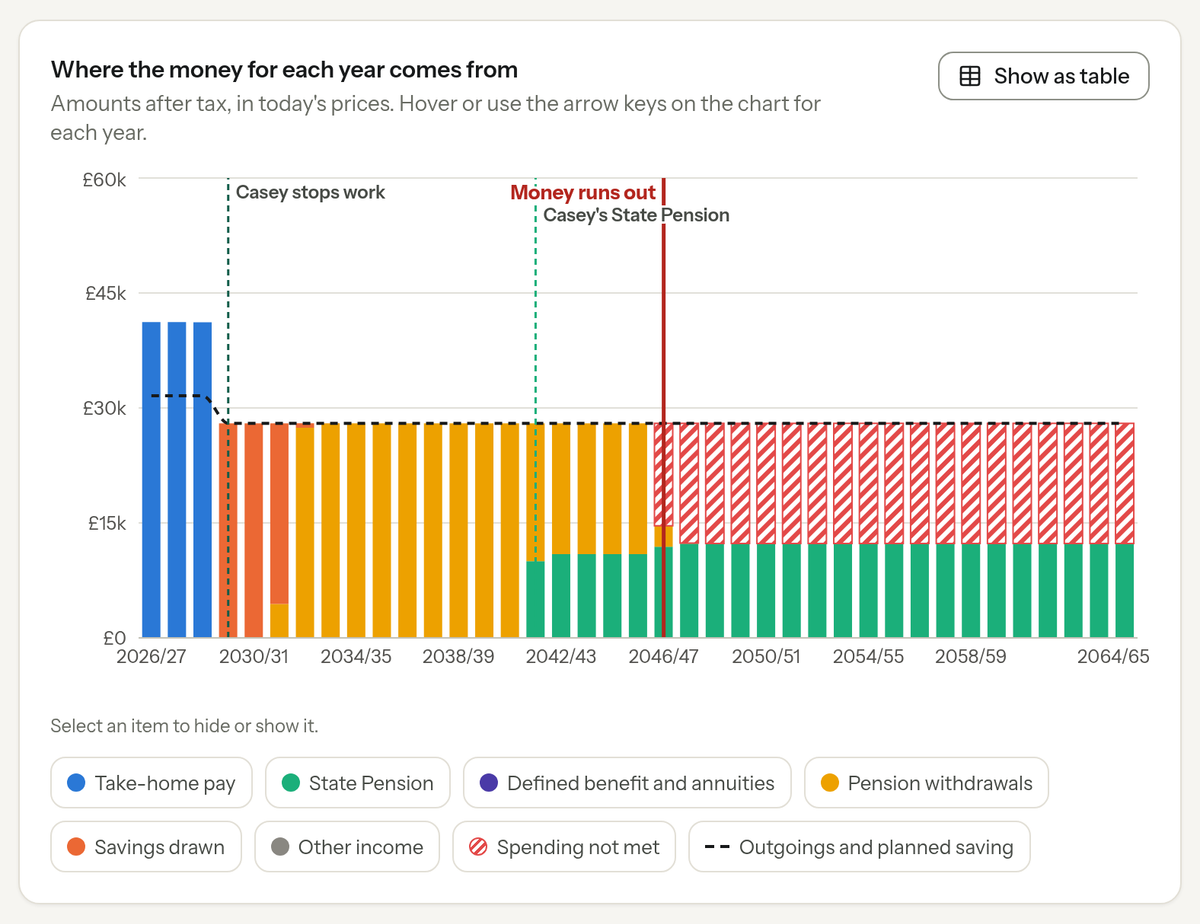
In this example, Casey stops work at 55, in 2029/30. The pension cannot be drawn until 57, the normal minimum pension age from 6 April 2028, so savings meet spending at 55 and 56. Pension withdrawals start at 57 and the State Pension at 67, and the money runs out in 2046/47, at 72, when £13,367 of spending is not met, in today's prices. Casey is an invented example, and the chart is an illustration of the planner's arithmetic, not a forecast.
Assumes 2.5% inflation a year and steady growth of 5% a year on pensions and ISAs, and 3% on cash and the home, before charges. Tax rules are those for 2026/27 and later years as now legislated, and can change. Real returns vary, and the value of investments can go down as well as up.
Open this example in the plannerDownload Casey's example plan (a JSON file: in the planner, choose File, then Open a saved file)
Key facts
- There is no default retirement age in the UK. People can stop work at any age, and can keep working after State Pension age.
- The normal minimum pension age rises from 55 to 57 on and after 6 April 2028, except for people with a protected pension age and members of the firefighters', police and armed forces schemes.
- State Pension age is rising from 66 to 67 between 2026 and 2028, and stopping work earlier does not bring it forward.
- The full new State Pension, £241.30 a week in 2026/27, needs 35 National Insurance qualifying years, and any State Pension needs at least 10.
- In Casey's invented example, stopping work at 55 means savings pay for two years before the pension can be drawn at 57.
- The planner uses the qualifying years entered for each person and does not change them when the age work stops is changed.
There is no fixed age to retire in the UK. What depends on age is when money can be drawn: private pensions usually from 55, rising to 57 on 6 April 2028, and the State Pension from State Pension age. Stopping work earlier means more years to pay for and fewer years of earning and saving, so the same savings have to stretch further.
When can you take money from a pension?
The normal minimum pension age is the earliest age at which most people can take money from a pension without an unauthorised payments tax charge. HMRC's policy paper sets out that it rises from 55 to 57 on and after 6 April 2028.
- Ill health. Benefits can be paid earlier to someone retiring because of ill health.
- Protected pension ages. People who had a right under their scheme's rules, before 4 November 2021, to take benefits at 55 or earlier may keep that age.
- Some public service schemes. Members of the firefighters', police and armed forces schemes are not affected by the rise.
- Scheme rules. A scheme can set a later age than the minimum.
Someone without a protected pension age who stops work at 55 after that date has two years in which savings, other income or earnings have to meet spending. The planner applies the minimum pension age by tax year, 55 up to 2027/28 and 57 from 2028/29, unless a pension access age is entered for the person, for example for a protected pension age.
When does the State Pension start?
The State Pension starts at State Pension age, which is set by date of birth. It is 66 and is rising to 67 between 2026 and 2028, and GOV.UK's State Pension age checker gives the date for any date of birth. It does not change with the age work stops.
The amount depends on National Insurance qualifying years. The full new State Pension is £241.30 a week in 2026/27 and needs 35 qualifying years, and any State Pension needs at least 10. Years without work may not count unless they are covered by National Insurance credits or voluntary contributions, and a State Pension forecast shows a person's own record. The planner uses the qualifying years entered for each person and does not change them when the age work stops changes.
What does retiring at 55 compared with 67 look like?
Casey is an invented example: 52, earning £55,000 a year, with a £250,000 workplace pension, £60,000 of savings in cash and an ISA, and a home owned outright, spending £28,000 a year. The two scenarios differ only in the age Casey stops work.
| In Casey's example | Stops work at 55 | Stops work at 67 |
|---|---|---|
| First year without work | 2029/30 | 2041/42 |
| Pension first drawn | 2031/32, at 57 | 2053/54, at 79 |
| State Pension from | 2041/42, at 67 | 2041/42, at 67 |
| Money runs out | 2046/47, at 72 | Not before the plan ends, at 90 |
| Years in which spending is not met | 19 | None |
| Left in savings and pensions at the end, at 90 | Nothing | £768,500 |
Stopping at 55, Casey's savings meet spending at 55 and 56. The pension is first drawn at 57, the normal minimum pension age from 6 April 2028, and the State Pension starts at 67. The money runs out in 2046/47, at 72: from then on only the State Pension is left, and £13,367 of spending is not met that year, in today's prices.
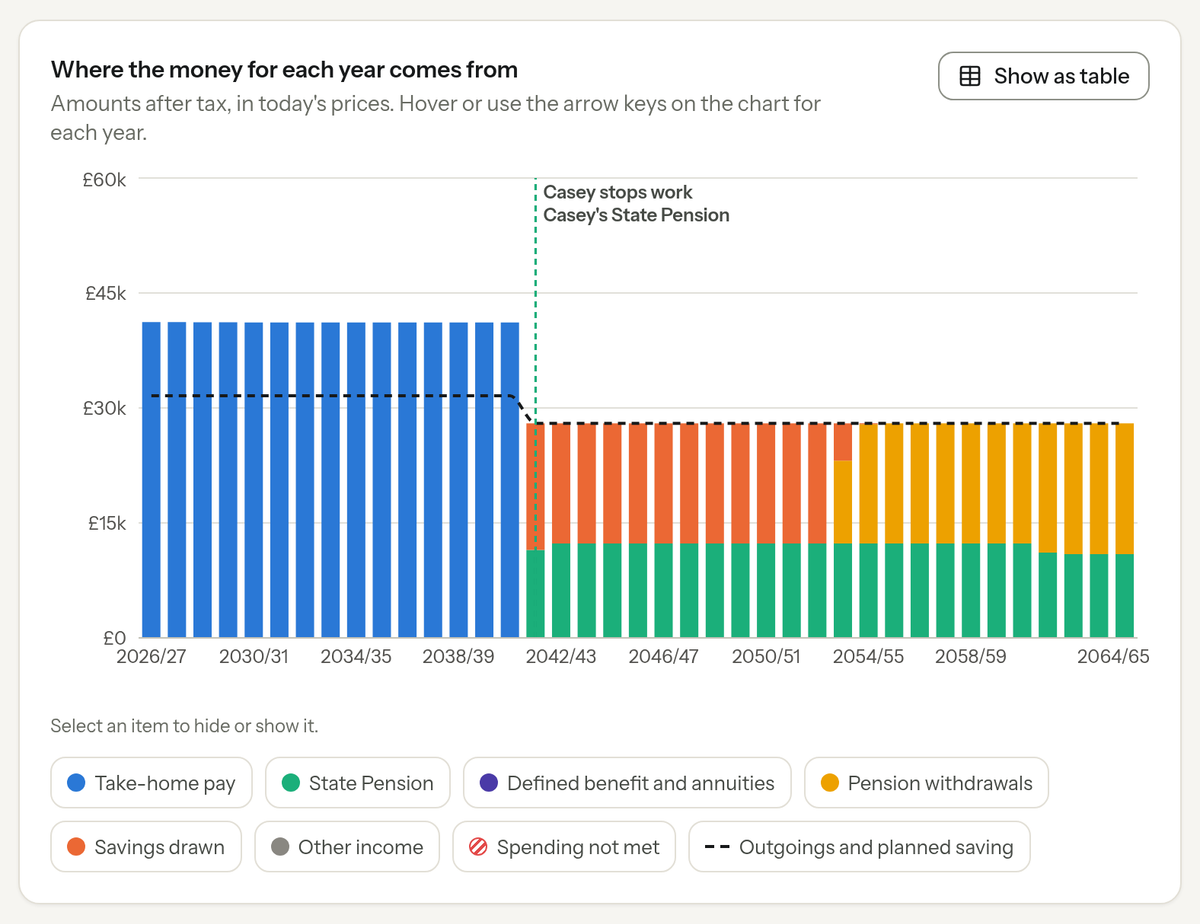
Stopping at 67, Casey works for 12 more years. Earnings meet spending, spare income is saved, the pension has longer to grow, and there are fewer years to pay for. Spending is met in every year to 90, with £768,500 left in savings and pensions at the end, in today's prices.
The planner counts money, not time. It does not weigh 12 more years of work against the money, or take account of health, family or what a person wants from those years. Which of these, if either, suits someone depends on their circumstances.
What this looks like in the planner
The picture at the top of this page is Casey's Cash flow view stopping work at 55: take-home pay until then, savings for two years, pension withdrawals from 57, the State Pension from 67, and a red line where the money runs out. The same plan stopping at 67 looks like this.
 Open this example in the planner.
In this example, the same person stops work at 67 instead, in 2041/42, the year the State Pension starts. Savings are used first and the pension from 79, and spending is met in every year to 90, with £768,500 left in savings and pensions at the end, in today's prices. Casey is an invented example, and the chart is an illustration of the planner's arithmetic, not a forecast.
Assumes 2.5% inflation a year and steady growth of 5% a year on pensions and ISAs, and 3% on cash and the home, before charges. Tax rules are those for 2026/27 and later years as now legislated, and can change. Real returns vary, and the value of investments can go down as well as up.
Open this example in the plannerDownload Casey's example plan (a JSON file: in the planner, choose File, then Open a saved file)
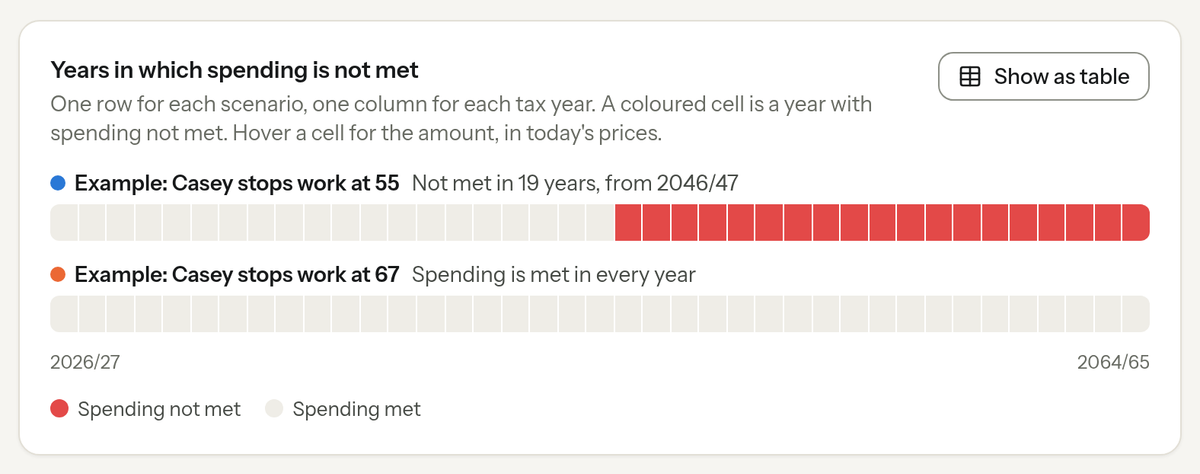
The Compare view shows the years in which spending is not met in each scenario.
 Open this example in the planner.
In this example, Casey stops work at 55 or 67, with everything else the same. Stopping at 55, spending is not met in 19 years, from 2046/47, at 72; stopping at 67, it is met in every year. Casey is an invented example, and the chart is an illustration of the planner's arithmetic, not a forecast.
Assumes 2.5% inflation a year and steady growth of 5% a year on pensions and ISAs, and 3% on cash and the home, before charges. Tax rules are those for 2026/27 and later years as now legislated, and can change. Real returns vary, and the value of investments can go down as well as up.
Open this example in the plannerDownload Casey's example plan (a JSON file: in the planner, choose File, then Open a saved file)
Open Casey's example in the planner, open the scenario stopping at 67, or compare the two. The example is invented, and its growth rates are assumptions: real returns vary, and the value of investments can go down as well as up.
What does the planner leave out here?
- The National Insurance record. Qualifying years are entered by hand. The planner does not count them from the years worked, or add National Insurance credits or voluntary contributions.
- Protected pension ages and ill health. The planner uses the normal minimum pension age unless a pension access age is entered by hand. Ill-health early retirement is not modelled.
- Steady growth. Each account grows at one steady rate, so a fall in markets just after work stops is not shown.
- Benefits. Benefits that someone under State Pension age might claim are not modelled.
What the planner simplifies or leaves out lists the rest.
Where can I get free guidance about retiring early?
Pension Wise, from MoneyHelper, offers free, impartial guidance appointments about the options for a defined contribution pension to people aged 50 or over, and to some younger people, such as those retiring early because of ill health. MoneyHelper gives free guidance on money and pensions to anyone. Personal advice comes from a regulated financial adviser, usually for a fee; financial guidance and advice explains the difference.
Change the inputs to your own in the planner to see the same calculation for your own figures, year by year. The planner simplifies some things, and what the planner simplifies or leaves out lists them.
Change the inputs to your own in the planner to see what stopping work at different ages leads to for your own figures.
Open the plannerFrequently asked questions
Can you actually retire at 55?
Anyone can stop work at any age; what depends on age is when money can be drawn. Private pensions can usually be drawn from 55 now, and for most people from 57 on and after 6 April 2028, unless a scheme gives a protected pension age or someone retires early because of ill health. The State Pension starts at State Pension age, so the years in between are paid for from savings, other income, or a pension once it can be drawn.
What is the minimum pension age from 2028?
The normal minimum pension age is the earliest age at which most people can take money from a pension without an unauthorised payments tax charge. It rises from 55 to 57 on and after 6 April 2028. Members of the firefighters', police and armed forces public service schemes are not affected, and people who had a right under their scheme's rules, before 4 November 2021, to take benefits at 55 or earlier may have a protected pension age.
When can I get my State Pension?
At State Pension age, which depends on date of birth. It is 66 and is rising to 67 between 2026 and 2028, and GOV.UK's State Pension age checker gives the date for any date of birth. The State Pension does not start earlier if work stops earlier. Claiming it later than State Pension age (deferring it) for at least 9 weeks increases the weekly amount.
Does retiring early reduce your State Pension?
It can. The new State Pension depends on National Insurance qualifying years, 35 for the full amount and at least 10 for any. Years without work or credits can leave gaps, and some gaps can be filled with voluntary contributions; a State Pension forecast shows your own record. The planner uses the qualifying years you enter and does not change them when you change the age work stops.
How much money do you need to retire at 55?
There is no set amount. It depends on spending, how long the money has to last, other income, growth, charges and tax. In Casey's invented example, with a £250,000 pension, £60,000 of savings and spending of £28,000 a year, stopping work at 55 runs out of money at 72 and stopping at 67 does not, on the assumptions given with the charts.
Try this example in the planner
Casey's example opens on the Cash flow view stopping work at 55, next to the same plan stopping at 67. Changing the age work stops, the spending or the savings shows how the years paid for from savings move.
The example is invented. It opens as a scenario of its own that you can change, and anything of yours that is open stays as it is.
Download Casey's example plan as a JSON file, and open it in the planner with File, then Open a saved file.
Sources
Checked against these sources on , for the 2026/27 tax year.
- Increasing Normal Minimum Pension Age (HMRC, GOV.UK) (opens in a new tab) (gov.uk)
- Check your State Pension age (GOV.UK) (opens in a new tab) (gov.uk)
- State Pension age timetable (DWP, GOV.UK) (opens in a new tab) (gov.uk)
- Early retirement, your pension and benefits (GOV.UK) (opens in a new tab) (gov.uk)
- The new State Pension: what you'll get (GOV.UK) (opens in a new tab) (gov.uk)
- Voluntary National Insurance (GOV.UK) (opens in a new tab) (gov.uk)
- Personal pensions: how you can take your pension (GOV.UK) (opens in a new tab) (gov.uk)
- Pension Wise (MoneyHelper) (opens in a new tab) (moneyhelper.org.uk)